Partly removed restriction in the cylinder head? - Honda ST50

Thomas H.

Member
Hi,

I've bought a nicely restored Honda ST50 engine for my little project.
The engine's looking nice in general, and I'm overall very pleased with the result.
You can see pictures that was taken during the process here:
http://mechmania.net/2016/10/05/engine-building/

I've got one question though.
I was told that the engine had been derestricted, and as far as I can see (from browsing through various sites on the web) the restriction itself should be in the cylinderhead in this model, in order to limit the amount of air/gasoline that gets through from the manifold. This should be a piece of metal, that should be removable in older models (mine's from 1973, so should be as old as it gets).

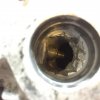
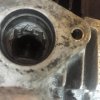
I took off the carb and manifold, and saw what you see on the attached pictures.
Is this what they're all talking about, and have the metal piece simply just only been partly (and poorly?) removed?
It looks as if the piece of metal is "contained" within a thin metal ring.

To be honest I would like to remove this properly, also so that I might be able to put in a new restriction at a later point of time if I should choose this option. Have any of you got any experience with this, do's and dont's?

attachment.jpg

attachment.jpg
 

Attachments

  • Cylinder_head_manifold.jpg
    Cylinder_head_manifold.jpg
    28.2 KB · Views: 308
  • IMG_3091.jpg
    IMG_3091.jpg
    41.9 KB · Views: 335
Anyone got any knowledge regarding this?
One person told me that this is the way it looks originally - but that sounds a bit weird to me to be honest.

Any help would be appreciated.
 
If you're just running 50cc's it might not be much of a problem. If you're going bigger than that, I would pull the head, strip it bare, and go after the intake port with a Dremel and a small teardrop shaped carbide burr. I'm thinking Honda may have cast it differently on the earliest..."restricted" engines. Then the hack, hacked it up a bit. No matter what it is or how it got there, it's not good, even for 50cc. Clean it up, throw it out, or give it a whirl and see how she runs.
 
If you're just running 50cc's it might not be much of a problem. If you're going bigger than that, I would pull the head, strip it bare, and go after the intake port with a Dremel and a small teardrop shaped carbide burr. I'm thinking Honda may have cast it differently on the earliest..."restricted" engines. Then the hack, hacked it up a bit. No matter what it is or how it got there, it's not good, even for 50cc. Clean it up, throw it out, or give it a whirl and see how she runs.

Hi,

Thanks a lot for the answer - and the confirmation that I was looking for.
I really appreciate it :) I'll try and figure out what to do, perhaps I can make it look a bit better than now ;)
Don't believe that I'll go bigger than 50cc though.

Guy that I bought it from said that this was the way it should look originally, which I also had a hard time believing.
I wish you a nice evening.
 
I've got one of those too :)

Yes, your top end has been derestricted - poorly.

The restrictor looks like a short rod with a hole in the middle - or a stack of coins if you like. On the outside it has a groove with a expanding circlip in it. Can be extracted using a long thin bolt and a suitable pulling tool. Yours has long since been removed and some sorry redneck has tried to remove the casting metal revealed. Looks like a hammer + screwdriver job. Ugh...

You may consider not mangling your OE component any further. This particular part is as rare as rocking horse shit, and you might just want to preserve it in its current state, perhaps sell it on to someone enthusiastic enough to want it because its the genuine article - and then buy yourself a brand new replacement part with a proper intake duct. Visually the two will be 99% identical, you should be able to make a little profit and you get an engine with a new top end.

You don't happen to be situated in Denmark? I am. And, like you, I've made a small site on the internet, telling a story (much similar to the one on your site) of restoration and the process.
It's on Google+ and recently I moved the pictures to a facebook-group created for that purpose.
Fønix projektet on Google+
DaxMC DK
However, unlike you I've focused on rebuilding the engine and simply reused the frame for now.
 
Last edited:
Good stuff stormbringer.

I have a 88 ST50 from Germany. The intake is bolted to the head with one-way, or tamper-proof screws. This thread makes me wonder if I have the restrictor in the head that came on the bike. I never removed the intake manifold, I just packed the motor away for safe keeping. I might get it out one day and drill off the screw heads for a look.
https://lilhonda.com/webboard/showthread.php?t=16864&highlight=
 
Hi,

Thanks a lot for the detailed description.
As you can see the engine was about the only thing that I wasn't quite ready to try and rebuild ;-)
But as I've written on my site, this will definetely be a project of mine further down the road.

I'll take a look at your site and send you a PM, - you're spot on, I'm from Denmark as well :-)

/Thomas

I've got one of those too :)

Yes, your top end has been derestricted - poorly.

The restrictor looks like a short rod with a hole in the middle - or a stack of coins if you like. On the outside it has a groove with a expanding circlip in it. Can be extracted using a long thin bolt and a suitable pulling tool. Yours has long since been removed and some sorry redneck has tried to remove the casting metal revealed. Looks like a hammer + screwdriver job. Ugh...

You may consider not mangling your OE component any further. This particular part is as rare as rocking horse shit, and you might just want to preserve it in its current state, perhaps sell it on to someone enthusiastic enough to want it because its the genuine article - and then buy yourself a brand new replacement part with a proper intake duct. Visually the two will be 99% identical, you should be able to make a little profit and you get an engine with a new top end.

You don't happen to be situated in Denmark? I am. And, like you, I've made a small site on the internet, telling a story (much similar to the one on your site) of restoration and the process.
It's on Google+ and recently I moved the pictures to a facebook-group created for that purpose.
Fønix projektet on Google+
DaxMC DK
However, unlike you I've focused on rebuilding the engine and simply reused the frame for now.
 
I expect that it would be possible to open the intake port to normal, unrestricted, size, maybe even with a configuration that's closer to optimal. In theory, raising both the floor and roof of the port, such that you end up with the same volume as an unrestricted, stock, head would improve flow efficiency. Looks like there's plenty of cubic metal, just waiting for the burrs & cartridge rolls. That said, about the only logical motivation would be wanting the challenge. The only way to know the actual flow would be testing on a flow bench...and who has the resources to get access to one, plus the talent to use it? Theory and reality don't always agree, meaning that the end result could be substandard. 49cc & 72cc heads are dime a dozen as used parts and the CT70 version has pretty good ports in stock form. That virtually relegates this rare piece to the shelf, or possibly the purist-collector market for all but a dedicated & skilled few.
 
I'm always up for a challenge ;) So might try and see if I can fix it - but first I'll see if the seller would be willing to do it - instead of me destroying something while trying.
Not quite satisfied with the look of this, he should have told me at least.
Thanks for all the help to all of you.

Always enjoy coming here for all this valuable feedback.
Kind and helpful people, which is more that can be said about various other boards.

Have a nice evening.

/Thomas
 
More than anything, it'll be a war of attrition. With that much material to carve & sculpt, it'll be on the painstaking side, one way or another. Still, I expect that this head can be transformed into a decent part.
 
Back
Top